操作系统 - 信号量
在操作系统中,信号量用于确保正确的进程同步,并在多个进程并发访问共享资源时避免竞争条件。阅读本章以了解信号量的概念、类型、操作以及它们在操作系统中的实现方式。
- 用于进程同步的信号量
- 信号量的类型
- 信号量的工作原理
- 信号量的实现
- 信号量的优点
- 信号量的缺点
用于进程同步的信号量
信号量是一种变量(通常为整数类型),用于在并发系统中控制多个进程对公共资源的访问。通过控制对共享资源的访问,信号量可以防止临界区问题,并在多处理系统中确保进程同步。
信号量定义了两种原子操作:wait(S),如果 S 为正则递减信号量 S;signal(S),递增 S,从而实现进程同步。下面部分将详细解释这些操作。
Wait 操作
wait 操作在其参数 S 为正时递减 S。如果 S 为负或零,则不执行任何操作。该操作检查信号量的值。如果值为大于 0,则进程继续执行并将 S 递减 1。如果值为 0,则进程被阻塞(等待),直到 S 变为正。
wait(S) {
   while (S <= 0);
   S--;
}
Signal 操作
signal 操作递增其参数 S。进程使用完共享资源后,执行 signal 操作,将信号量的值增加 1,从而可能解除其他等待进程的阻塞,允许它们访问资源。
signal(S) {
   S++;
}
信号量的类型
信号量主要有两种类型:计数信号量和二进制信号量。详情如下 −
- 二进制信号量
- 计数信号量
1. 二进制信号量
二进制信号量的值为限制在 0 和 1之间。wait 操作仅在信号量为 0 时生效。有时实现二进制信号量比计数信号量更容易。
二进制信号量用于系统中仅有一个资源实例的场景。例如,如果系统中只有一个打印机,可以使用二进制信号量来控制对打印机的访问。
2. 计数信号量
计数信号量是具有无限制值域的整数值信号量。它们用于协调资源访问,信号量的计数值表示可用资源的数量。如果添加资源,信号量计数值自动递增;如果移除资源,则计数值递减。
当有多个资源实例可用时使用计数信号量。例如,如果有 5 个相同的资源,则将信号量 S 初始化为 5。每次进程获取一个资源时,S 递减 1;释放时,S 递增 1。当 S=0 时,表示没有可用资源,请求资源的进程将被阻塞,直到有资源被释放。
信号量的工作原理
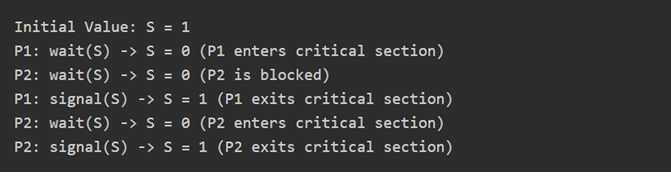
为了理解信号量的工作原理,考虑两个进程 P1 和 P2 之间的情况,它们需要访问一个共享资源。最初,信号量 S 被设置为 1,这表示资源可用。
状态 1 − P1 和 P2 都处于它们的非关键区。
状态 2 − P1 想要进入其关键区,因此它执行 wait(S)。于是 S 被递减为 0。
状态 3 − P1 处于关键区,现在 P2 也想要进入其关键区,因此它执行 wait(S)。由于 S 为 0,P2 被阻塞并等待。
状态 4 − P1 完成其关键区并执行 signal(S)。于是 S 被递增为 1。
状态 5 − P2 被解除阻塞并执行 wait(S)。于是 S 被递减为 0,P2 进入其关键区。
状态 6 − P2 完成其关键区并执行 signal(S)。于是 S 被递增为 1。
下图展示了上述步骤 −
信号量实现
以下是如何使用 POSIX threads 在 C++ / Python / Java 中实现二进制信号量的示例。
import threading
import time

semaphore = threading.Semaphore(1)
def process(id):
    print(f"Process {id} is trying to enter critical section")
    semaphore.acquire()  # 等待操作
    print(f"Process {id} has entered critical section")
    time.sleep(1)  # 模拟临界区
    print(f"Process {id} is leaving critical section")
    semaphore.release()  # 信号操作
threads = []
for i in range(5):
    t = threading.Thread(target=process, args=(i,))
    threads.append(t)
    t.start()
for t in threads:
    t.join()
上述代码的输出将为 −
Process 0 is trying to enter critical section
Process 0 has entered critical section
Process 1 is trying to enter critical section
Process 2 is trying to enter critical section
Process 3 is trying to enter critical section
Process 4 is trying to enter critical section
...
#include <iostream>
#include <semaphore.h>
#include <thread>
#include <vector>
using namespace std;

sem_t semaphore;
void process(int id) {
    cout << "Process " << id << " is trying to enter critical section" << endl;
    sem_wait(&semaphore); // 等待操作
    cout << "Process " << id << " has entered critical section" << endl;
    this_thread::sleep_for(chrono::seconds(1)); // 模拟临界区
    cout << "Process " << id << " is leaving critical section" << endl;
    sem_post(&semaphore); // 信号操作
}

int main() {
    sem_init(&semaphore, 0, 1); // 初始化二进制信号量
    vector<thread> threads;
    for (int i = 0; i < 5; i++) {
        threads.push_back(thread(process, i));
    }
    for (auto& t : threads) {
        t.join();
    }
    sem_destroy(&semaphore);
    return 0;
}
上述代码的输出将为 −
Process 0 is trying to enter critical section
Process 0 has entered critical section
Process 1 is trying to enter critical section
Process 2 is trying to enter critical section
Process 3 is trying to enter critical section
Process 4 is trying to enter critical section
...
import java.util.concurrent.Semaphore;
import java.util.concurrent.ExecutorService;
import java.util.concurrent.Executors;

public class SemaphoreExample {
    static Semaphore semaphore = new Semaphore(1);
    public static void process(int id) {
        try {
            System.out.println("Process " + id + " is trying to enter critical section");
            semaphore.acquire(); // 等待操作
            System.out.println("Process " + id + " has entered critical section");
            Thread.sleep(1000); // 模拟临界区
            System.out.println("Process " + id + " is leaving critical section");
        } catch (InterruptedException e) {
            e.printStackTrace();
        } finally {
            semaphore.release(); // 信号操作
        }
    }
    public static void main(String[] args) {
        ExecutorService executor = Executors.newFixedThreadPool(5);
        for (int i = 0; i < 5; i++) {
            final int id = i;
            executor.submit(() -> process(id));
        }
        executor.shutdown();
    }
}
上述代码的输出将为 −
Process 0 is trying to enter critical section
Process 0 has entered critical section
Process 1 is trying to enter critical section
Process 2 is trying to enter critical section
Process 3 is trying to enter critical section
Process 4 is trying to enter critical section
...
信号量的优点
信号量的一些优点如下 −
- 信号量严格遵循互斥原则,一次只允许一个进程进入临界区。它们比其他一些同步方法效率高得多。
- 信号量消除了由于忙等待造成的资源浪费,因为处理器时间不会无谓地用于检查进程访问临界区的条件是否满足。
- 信号量在微内核的机器无关代码中实现,使其具有机器无关性。
- 由于信号量内部的等待队列,不会消耗处理时间和资源。这是因为只有在满足特定条件后,操作才被允许进入临界区。
- 用户可以灵活管理资源。
- 它们不允许超过一个操作进入临界区。Mutex 被实现,这些比其他同步方法效率显著更高。
信号量的缺点
信号量的一些缺点如下 −
- 信号量较为复杂,因此必须以正确的顺序实现等待和信号操作,以防止死锁。
- 信号量不适合大规模使用,因为它们会导致模块性的丧失。这是因为等待和信号操作指定了结构化系统布局的创建。
- 信号量可能导致优先级反转,即低优先级进程在高优先级进程之前访问临界区。
结论
信号量是操作系统中用于控制多个进程访问共享资源的同步机制。我们讨论了两种类型的信号量:二进制信号量和计数信号量。我们还通过示例解释了信号量的工作原理,并提供了 C++、Python 和 Java 的代码片段来演示其实现。