HTML - 表格
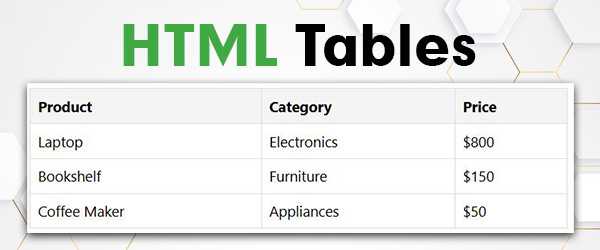
HTML 表格以行和列的结构化格式表示数据,例如文本、图像等。
HTML 表格提供了一种视觉结构,有助于清晰度和理解,是 Web 开发中的基本元素。
为什么使用 HTML 表格?
HTML 表格用于各种原因,主要围绕有效组织和呈现数据。一些关键用途包括 −
- 结构化数据 − 表格为组织和显示数据提供了一个连贯的结构,使用户更容易解释信息。
- 比较呈现 − 当需要并排比较不同数据集时,例如两个概念之间的差异,表格提供了一种清晰且视觉上易访问的格式。
- 表格数据表示 − 自然适合行和列的信息,例如时间表、统计数据或价格表,可以使用 HTML 表格很好地表示。
创建 HTML 表格
您可以使用 <table> 标签以及几个定义表格内部结构和内容的标签在 HTML 中创建表格。与 <table> 标签一起使用的主要标签是 <tr>、<td> 和 <th>。
在 HTML 中创建表格涉及几个定义结构和内容的元素。主要使用的标签是 <table>, <tr>, <td>, 和 <th>。
- HTML <table> 标签:此标签用于创建表格,将行和列包裹在其中。
- HTML <tr> 标签:代表“table row”(表格行),用于在表格中创建一行。
- HTML <td> 标签:代表“table data”(表格数据),用于在一行中创建标准单元格。
- HTML <th> 标签:代表“table header”(表格标题),用于在一行中创建标题单元格。
HTML 表格结构 - 行和列
- 行:HTML 表格中的每一行使用 <tr> 标签定义。它包含一组表格单元格(<td> 或 <th>),代表该行中的单个元素。
- 列:实际数据或标题信息包含在表格单元格中。不同行中相同位置的单元格形成一列。
- 表格行由 <tr> 标签定义。要设置表格标题,我们使用 <th> 标签。要在表格单元格中插入数据,使用 <td> 标签。
- HTML 中的表格由表格行和列中的表格单元格组成。
- 表格标题由 <th>...</th> 定义。<th> 中的数据是表格列的标题。
- 每个表格单元格由 <td>...</td> 标签定义。<td> 标签中的数据是表格行和列的内容。
- 每个表格行以 <tr> ....</tr> 标签开始。
- 我们使用样式表为表格创建边框。
示例
考虑一个表示产品简单列表及其类别和价格的表格。这个基本表格结构以清晰的表格格式组织数据,便于阅读和理解。这里,border 是 <table> 标签的属性,用于为所有单元格添加边框。如果不需要边框,则可以使用 border="0"。
<!DOCTYPE html>
<html>
<body>
    <table border="1">
    <tr>
       <th>Product</th>
       <th>Category</th>
       <th>Price</th>
    </tr>
    <tr>
       <td>Laptop</td>
       <td>Electronics</td>
       <td>$800</td>
    </tr>
    <tr>
       <td>Bookshelf</td>
       <td>Furniture</td>
       <td>$150</td>
    </tr>
    <tr>
       <td>Coffee Maker</td>
       <td>Appliances</td>
       <td>$50</td>
    </tr>
    </table>
</body>
</html>
样式化 HTML 表格
你也可以使用 CSS 属性来样式化 HTML 表格,从而赋予其自定义外观。你可以创建 class 来为表格应用样式,或者直接编写内部 CSS 属性来样式化表格。
示例
在下面的示例中,我们使用一些 CSS 属性来样式化表格,使其更美观:
<!DOCTYPE html>
<html>
<head>
   <style>
   table {
      width: 100%;
      border-collapse: collapse;
      margin-bottom: 20px;
   }
   th, td {
      border: 1px solid #ddd;
      padding: 8px;
      text-align: left;
   }
   th {
      background-color: #f2f2f2;
   }
   </style>
</head>
<body>
    <h2>HTML Table</h2>
    <p>This table is 3*3 cells including table header.
    <table>
        <tr>
           <th>Header 1</th>
           <th>Header 2</th>
           <th>Header 3</th>
        </tr>
        <tr>
           <td>Data 1</td>
           <td>Data 2</td>
           <td>Data 3</td>
        </tr>
        <tr>
           <td>Data 4</td>
           <td>Data 5</td>
           <td>Data 6</td>
        </tr>
    </table>
</body>
</html>
表格背景颜色和图片
您可以使用 CSS 和 <table> 标签的属性来设置 HTML 表格的背景颜色和背景图片。
使用属性
以下是可与 <table> 标签一起使用以设置背景颜色和/或图片的属性:
-
bgcolor:bgcolor属性设置表格的背景颜色。<table bgcolor="#f0f0f0">
-
background:background属性设置背景图片。<table background="image.jpg">
使用 CSS 属性
使用 table 标签的属性是一种旧的(已过时)风格。建议您使用 CSS 来样式化 HTML 表格。background-color 和 background-image 属性分别用于设置背景颜色和图片。
table {
  background-color: #f0f0f0;
  background-image: url('image.jpg');
}
使用属性设置表格背景颜色和图片的示例
这里我们使用 <table> 标签的属性为表格设置背景颜色和图片:
<!DOCTYPE html>
<html>
<head>
   <title>HTML Table Background Color</title>
</head>
<body>
    <table border="1" bordercolor="green" bgcolor="yellow" background="/images/test.png">
       <tr>
          <th>Column 1</th>
          <th>Column 2</th>
          <th>Column 3</th>
       </tr>
       <tr>
          <td rowspan="2">Row 1 Cell 1</td>
          <td>Row 1 Cell 2</td>
          <td>Row 1 Cell 3</td>
       </tr>
       <tr>
          <td>Row 2 Cell 2</td>
          <td>Row 2 Cell 3</td>
       </tr>
       <tr>
          <td colspan="3">Row 3 Cell 1</td>
       </tr>
    </table>
</body>
</html>
使用 CSS 设置表格背景颜色和图片的示例
这里我们使用 CSS 属性为表格设置背景颜色和图片:
<!DOCTYPE html>
<html>
<head>
   <title>HTML Table Background Color</title>
   <style>
table {
  background-color: yellow;
  background-image: url('/images/test.png');
}
</style>
</head>
<body>
    <table>
       <tr>
          <th>Column 1</th>
          <th>Column 2</th>
          <th>Column 3</th>
       </tr>
       <tr>
          <td rowspan="2">Row 1 Cell 1</td>
          <td>Row 1 Cell 2</td>
          <td>Row 1 Cell 3</td>
       </tr>
       <tr>
          <td>Row 2 Cell 2</td>
          <td>Row 2 Cell 3</td>
       </tr>
       <tr>
          <td colspan="3">Row 3 Cell 1</td>
       </tr>
    </table>
</body>
</html>
表格宽度和高度
表格的宽度和高度可以使用属性或 CSS 属性来设置。这些值可以用像素或百分比来定义。
使用属性
以下属性可以设置表格的宽度和高度:
width:定义表格的宽度。<table width="80%">
height:定义表格的高度。<table height="200">
使用 CSS
以下 CSS 属性可以设置表格的宽度和高度:
width:定义表格的宽度。table { width: 80%; }height:定义表格的高度。table { height: 400px; }
使用属性设置表格宽度和高度的示例
在这里,我们使用 <table> 标签的属性来设置表格的宽度(80%)和高度(400px):
<!DOCTYPE html>
<html>
<head>
   <title>HTML Table Width/Height</title>
</head>
<body>
    <table border="1" width="80%" height="400">
        <tr>
          <th>Header 1</th>
          <th>Header 2</th>
        </tr>
        <tr>
          <td>Row 1, Column 1</td>
          <td>Row 1, Column 2</td>
        </tr>
        <tr>
          <td>Row 2, Column 1</td>
          <td>Row 2, Column 2</td>
        </tr>
    </table>
</body>
</html>
使用 CSS 设置表格宽度和高度的示例
在这里,我们使用 CSS 属性为表格设置宽度(80%)和高度(400px):
<!DOCTYPE html>
<html>
<head>
   <title>HTML Table Width/Height</title>
   <style>
   table{
       width: 80%;
       height: 400px;
   }
   </style>
</head>
<body>
    <table border="1">
        <tr>
          <th>Header 1</th>
          <th>Header 2</th>
        </tr>
        <tr>
          <td>Row 1, Column 1</td>
          <td>Row 1, Column 2</td>
        </tr>
        <tr>
          <td>Row 2, Column 1</td>
          <td>Row 2, Column 2</td>
        </tr>
    </table>
</body>
</html>
HTML 嵌套表格
嵌套 HTML 表格指的是在表格内部创建表格。你可以在任何 <td> 标签内使用 <table> 标签来创建表格,这会在主表格的单元格中创建另一个表格。
示例
在以下示例中,我们创建了嵌套表格:
<!DOCTYPE html>
<html>
<head>
    <title>HTML Nested Tables</title>
</head>

<body>
    <table border=1>
        <tr>
            <td> First Column of Outer Table </td>
            <td>
                <table border=1>
                    <tr>
                        <td> First row of Inner Table </td>
                    </tr>
                    <tr>
                        <td> Second row of Inner Table </td>
                    </tr>
                </table>
            </td>
        </tr>
        <tr>
            <td>
                <table border=1>
                    <tr>
                        <td> First row of Inner Table </td>
                    </tr>
                    <tr>
                        <td> Second row of Inner Table </td>
                    </tr>
                </table>
            </td>
            <td> First Column of Outer Table </td>

        </tr>
    </table>
</body>

</html>
表格相关标签参考
以下是表格相关的标签。您可以点击链接查看特定标签的详细说明,并点击“Try It”来练习其示例:
| Tag | 描述 |
|---|---|
| <table> | 用于创建 HTML 表格。 |
| <th> | 该标签定义表格的表头。 |
| <tr> | 该标签定义表格的一行。 |
| <td> | 该标签用于存储每个单元格的表格数据。 |
| <caption> | 该标签为表格指定标题。 |
| <colgroup> | 该标签描述表格中一列或多列的集合,用于格式化。 |
| <col> | 该标签用于提供有关列的信息。 |
| <thead> | 该标签用于定义表格的表头部分。 |
| <tbody> | 该标签用于定义表格的主体部分。 |
| <tfoot> | 该标签用于定义表格的表尾部分。 |