计数排序算法

- 计数排序算法
- 实现
计数排序是一种外部排序算法,它假设所有输入值都是位于 0 到 k 范围内的整数。然后通过对这些输入值进行数学计算,将它们放置在输出数组的正确位置。
该算法使用计数器来统计数字出现的频率,并据此进行排列。假设输入序列中数字 m 出现了 5 次,则该数字的计数器值为 5,在输出数组中重复 5 次。
计数排序算法
计数排序算法假设输入范围相对较小,其算法步骤如下 −
步骤 1 − 维护两个数组,一个是不重复输入元素大小的数组用于存储计数值,另一个是输入数组大小的数组用于存储输出。
步骤 2 − 将计数数组初始化为全零,并保持输出数组为空。
步骤 3 − 每次在输入列表中遇到一个元素时,将对应的计数器值加 1,直到遍历完输入列表。
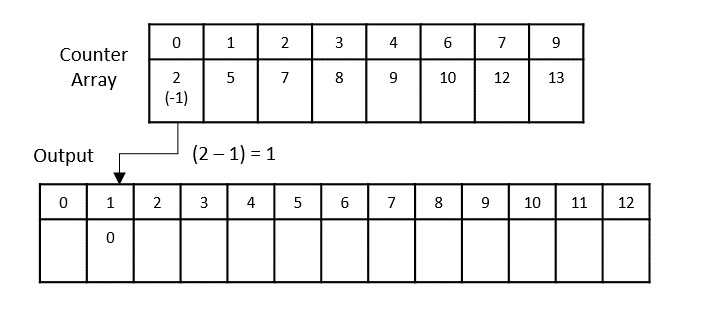
步骤 4 − 现在,在输出数组中,每次当计数器大于 0 时,将元素添加到其对应索引位置,即如果 0 的计数器为 2,则将 0 添加到输出数组的第 2 个位置(即索引 1)。然后将计数器值减 1。
步骤 5 − 重复步骤 4,直到所有计数器值变为 0。得到的结果列表即为输出列表。
COUNTING-SORT(A, B, k)
let C[0  k] be a new array
for i = 0 to k
C[i] = 0
for j = 1 to A.length
C[A[j]] = C[A[j]] + 1

// C[i] 现在包含等于 i 的元素个数。
for i = 1 to k
C[i] = C[i] + C[i  1]
// C[i] 现在包含小于等于 i 的元素个数。
for j = A.length downto 1
B[C[A[j]]] = A[j]
C[A[j]] = C[A[j  1]
分析
计数排序算法的平均情况时间复杂度与桶排序相同。它在 O(n) 时间内运行。
示例
考虑一个待排序的输入列表:0, 2, 1, 4, 6, 2, 1, 1, 0, 3, 7, 7, 9。
为了便于计算,我们从个位数开始。
步骤 1
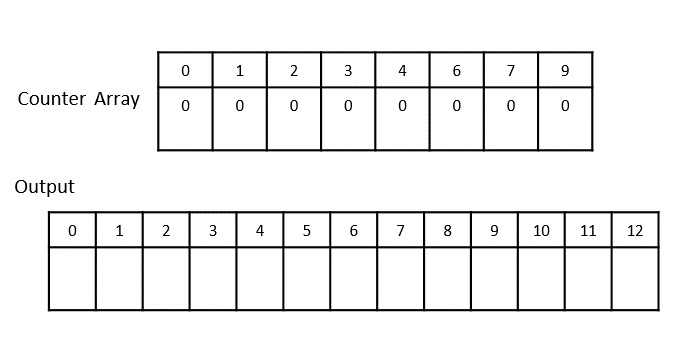
创建两个数组:一个用于存储计数器,另一个用于输出。将计数器数组初始化为零。
步骤 2
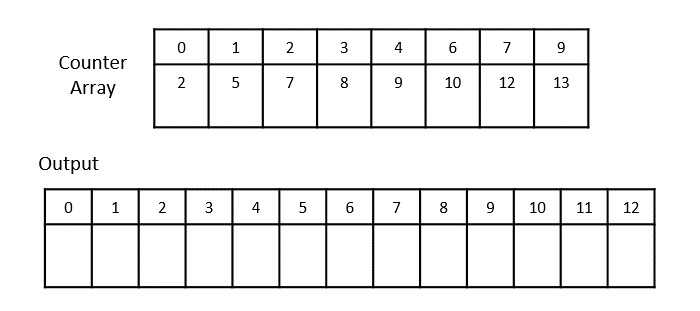
遍历输入列表并递增所有计数器值后,我们得到 −
步骤 3
现在,将元素推入输出列表的对应索引位置。
步骤 4
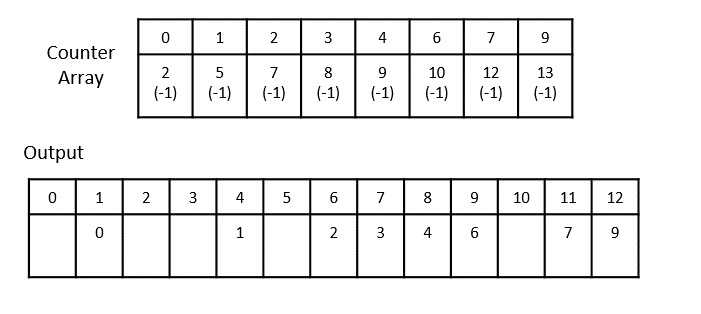
在输出数组中添加元素后,将计数器减 1。现在,1 被添加到第 4th 个索引。
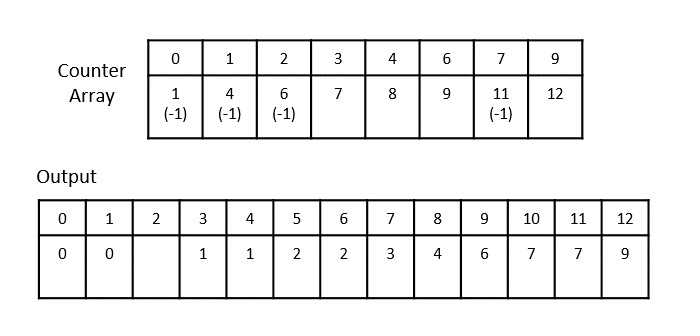
步骤 5
添加前一步索引之前剩余的值。
步骤 6
添加最后的值后,我们得到 −
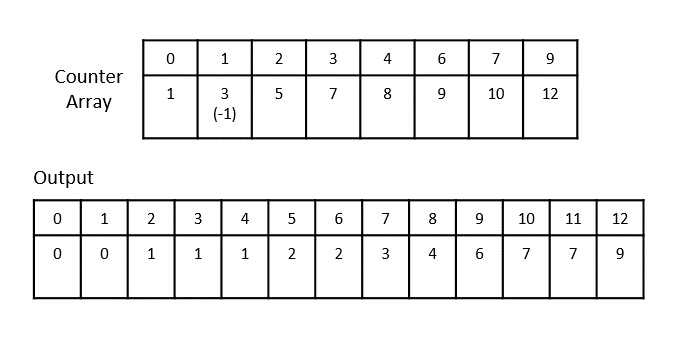
最终排序输出为:0, 0, 1, 1, 1, 2, 2, 3, 4, 6, 7, 7, 9
实现
计数排序的实现与算法密切相关,我们构建一个数组来存储输入数组中每个元素的频率。根据这些频率,将元素放置到输出数组中。重复元素在计数排序算法中也会被排序。
示例
在本章中,我们将查看用四种不同编程语言实现的计数排序程序。
#include<stdio.h>
int countingsort(int a[], int n){
   int i, j;
   int output[15], c[100];
   for (i = 0; i < 100; i++)
      c[i] = 0;
   for (j = 0; j < n; j++)
      ++c[a[j]];
   for (i = 1; i <= 99; i++)
      c[i] += c[i-1];
   for (j = n-1; j >= 0; j--) {
      output[c[a[j]] - 1] = a[j];
      --c[a[j]];
   }
   printf("\nAfter sorting array elements are: ");
   for (i = 0; i<n; i++)
      printf("%d ", output[i]);
}
void main(){
   int n , i;
   int a[] = {12, 32, 44, 8, 16};
   n = sizeof(a) / sizeof(a[0]);
   printf("Before sorting array elements are: ");
   for(int i = 0; i<n; i++){
       printf("%d " , a[i]);
   }
   countingsort(a, n);
}
输出
Before sorting array elements are: 12 32 44 8 16
After sorting array elements are: 8 12 16 32 44
#include<iostream>
using namespace std;
void countingsort(int a[], int n){
   int i, j;
   int output[15], c[100];
   for (i = 0; i < 100; i++)
      c[i] = 0;
   for (j = 0; j < n; j++)
      ++c[a[j]];
   for (i = 1; i <= 99; i++)
      c[i] += c[i-1];
   for (j = n-1; j >= 0; j--) {
      output[c[a[j]] - 1] = a[j];
      --c[a[j]];
   }
   cout << "\nAfter sorting array elements are: ";
   for (i = 0; i <n; i++)
      cout << output[i] << " ";
}
int main(){
   int n , i;
   int a[] = {12, 32, 44, 8, 16};
   n = sizeof(a) / sizeof(a[0]);
   cout<<"Before sorting array elements are: ";
   for(int i = 0; i<n; i++){
       cout<<a[i]<<" ";
   }
   countingsort(a, n);
   cout << "\n";
   return 0;
}
输出
Before sorting array elements are: 12 32 44 8 16
After sorting array elements are: 8 12 16 32 44
import java.io.*;
public class counting_sort {
   static void sort(int a[], int n) {
      int i, j;
      int output[] = new int[15];
      int c[] = new int[100];
      for (i = 0; i < 100; i++)
      c[i] = 0;
      for (j = 0; j < n; j++)
      ++c[a[j]];
      for (i = 1; i <= 99; i++)
      c[i] += c[i-1];
      for (j = n-1; j >= 0; j--) {
         output[c[a[j]] - 1] = a[j];
         --c[a[j]];
      }
      System.out.println("\nAfter sorting array elements are: ");
      for (i = 0; i < n; ++i)
      System.out.print(output[i] + " ");
   }
   public static void main(String args[]){
      int a[] = {12, 32, 44, 8, 16};
      int n = a.length;
      System.out.println("Before sorting array elements are: ");
      for(int i = 0; i<n; i++){
          System.out.print(a[i] + " ");
      }
      // Function call
      sort(a, n);
   }
}
输出
Before sorting array elements are:
12 32 44 8 16
After sorting array elements are:
8 12 16 32 44
output = []
def counting_sort(a, n):
    output = [0] * n
    c = [0] * 100
    for i in range(100):
        c[i] = 0
    for j in range(n):
        c[a[j]] += 1
    for i in range(1, 99):
        c[i] += c[i-1]
    for j in range(n-1, -1, -1):
        output[c[a[j]] - 1] = a[j]
        c[a[j]] -= 1
    print("After sorting array elements are: ")
    print(output)
a = [12, 32, 44, 8, 16]
n = len(a)
print("Before sorting array elements are: ")
print (a)
counting_sort(a, n)
输出
Before sorting array elements are:
[12, 32, 44, 8, 16]
After sorting array elements are:
[8, 12, 16, 32, 44]