Spring Boot - Rest Template
Rest Template 用于创建消费 RESTful Web Services 的应用程序。您可以使用 exchange() 方法来消费所有 HTTP 方法的 web services。下面的代码展示了如何创建 Rest Template 的 Bean 以自动注入 Rest Template 对象。
...
public class DemoApplication {
   public static void main(String[] args) {
      SpringApplication.run(DemoApplication.class, args);
   }
   @Bean
   public RestTemplate getRestTemplate() {
      return new RestTemplate();
   }
}
GET
使用 RestTemplate 的 exchange() 方法消费 GET API
假设这个 URL http://localhost:8080/products 返回以下 JSON,我们将使用 Rest Template 消费这个 API 响应,代码如下 −
[
   {
      "id": "1",
      "name": "Honey"
   },
   {
      "id": "2",
      "name": "Almond"
   }
]
要消费该 API,您需要遵循以下步骤 −
自动注入 Rest Template 对象。
使用 HttpHeaders 设置请求头。
使用 HttpEntity 包装请求对象。
为 exchange() 方法提供 URL、HttpMethod 和返回类型。
...
public class ConsumeWebService {
   @Autowired
   RestTemplate restTemplate;

   @GetMapping(value = "/template/products")
   public String getProductList() {
      HttpHeaders headers = new HttpHeaders();
      headers.setAccept(Arrays.asList(MediaType.APPLICATION_JSON));
      HttpEntity <String> entity = new HttpEntity<String>(headers);

      return restTemplate.exchange("
         http://localhost:8080/products", HttpMethod.GET, entity, String.class).getBody();
   }
}
POST
使用 RestTemplate 的 exchange() 方法消费 POST API
假设这个 URL http://localhost:8080/products 返回以下响应,我们将使用 Rest Template 消费这个 API 响应。
下面的代码是请求体 −
{
   "id":"3",
   "name":"Ginger"
}
下面的代码是响应体 −
Product is created successfully
要消费该 API,您需要遵循以下步骤 −
自动注入 Rest Template 对象。
使用 HttpHeaders 设置请求头。
使用 HttpEntity 包装请求对象。在此,我们将 Product 对象包装以发送到请求体。
为 exchange() 方法提供 URL、HttpMethod 和返回类型。
...
public class ConsumeWebService {
   @Autowired
   RestTemplate restTemplate;

   @PostMapping(value = "/template/products")
   public String createProducts(@RequestBody Product product) {
      HttpHeaders headers = new HttpHeaders();
      headers.setAccept(Arrays.asList(MediaType.APPLICATION_JSON));
      HttpEntity<Product> entity = new HttpEntity<Product>(product,headers);

      return restTemplate.exchange(
         "http://localhost:8080/products", HttpMethod.POST, entity, String.class).getBody();
   }
}
PUT
使用 RestTemplate 的 exchange() 方法消费 PUT API
假设这个 URL http://localhost:8080/products/3 返回以下响应,我们将使用 RestTemplate 来消费这个 API 响应。
下面的代码是 Request body −
{
   "name":"Indian Ginger"
}
下面的代码是 Response body −
Product is updated successfully
要消费这个 API,您需要遵循以下要点 −
Autowired RestTemplate 对象。
使用 HttpHeaders 设置请求头。
使用 HttpEntity 包装请求对象。这里,我们将 Product 对象包装后发送到请求体中。
为 exchange() 方法提供 URL、HttpMethod 和返回类型。
...
public class ConsumeWebService {
   @Autowired
   RestTemplate restTemplate;

   @PutMapping(value = "/template/products/{id}")
   public String updateProduct(@PathVariable("id") String id, @RequestBody Product product) {
      HttpHeaders headers = new HttpHeaders();
      headers.setAccept(Arrays.asList(MediaType.APPLICATION_JSON));
      HttpEntity<Product> entity = new HttpEntity<Product>(product,headers);

      return restTemplate.exchange(
         "http://localhost:8080/products/"+id, HttpMethod.PUT, entity, String.class).getBody();
   }
}
DELETE
使用 RestTemplate 的 exchange() 方法消费 DELETE API
假设这个 URL http://localhost:8080/products/3 返回以下响应,我们将使用 RestTemplate 来消费这个 API 响应。
下面显示的代码行是 Response body −
Product is deleted successfully
要消费这个 API,您需要遵循以下要点 −
Autowired RestTemplate 对象。
使用 HttpHeaders 设置请求头。
使用 HttpEntity 包装请求对象。
为 exchange() 方法提供 URL、HttpMethod 和返回类型。
...
public class ConsumeWebService {
   @Autowired
   RestTemplate restTemplate;

   @DeleteMapping(value = "/template/products/{id}")
   public String deleteProduct(@PathVariable("id") String id) {
      HttpHeaders headers = new HttpHeaders();
      headers.setAccept(Arrays.asList(MediaType.APPLICATION_JSON));
      HttpEntity<Product> entity = new HttpEntity<Product>(headers);

      return restTemplate.exchange(
         "http://localhost:8080/products/"+id, HttpMethod.DELETE, entity, String.class).getBody();
   }
}
示例 - Rest Template 的使用
完整的 Rest Template Controller 类文件如下所示 −
ConsumeWebService.java
package com..demo.controller;

import java.util.Arrays;

import org.springframework.beans.factory.annotation.Autowired;
import org.springframework.http.HttpEntity;
import org.springframework.http.HttpHeaders;
import org.springframework.http.HttpMethod;
import org.springframework.http.MediaType;
import org.springframework.web.bind.annotation.DeleteMapping;
import org.springframework.web.bind.annotation.GetMapping;
import org.springframework.web.bind.annotation.PathVariable;
import org.springframework.web.bind.annotation.PostMapping;
import org.springframework.web.bind.annotation.PutMapping;
import org.springframework.web.bind.annotation.RequestBody;
import org.springframework.web.bind.annotation.RestController;
import org.springframework.web.client.RestTemplate;

import com..demo.model.Product;

@RestController
public class ConsumeWebService {
   @Autowired
   RestTemplate restTemplate;

   @GetMapping(value = "/template/products")
   public String getProductList() {
      HttpHeaders headers = new HttpHeaders();
      headers.setAccept(Arrays.asList(MediaType.APPLICATION_JSON));
      HttpEntity<String> entity = new HttpEntity<String>(headers);

      return restTemplate.exchange(
         "http://localhost:8080/products", HttpMethod.GET, entity, String.class).getBody();
   }
   @PostMapping(value = "/template/products")
   public String createProducts(@RequestBody Product product) {
      HttpHeaders headers = new HttpHeaders();
      headers.setAccept(Arrays.asList(MediaType.APPLICATION_JSON));
      HttpEntity<Product> entity = new HttpEntity<Product>(product,headers);

      return restTemplate.exchange(
         "http://localhost:8080/products", HttpMethod.POST, entity, String.class).getBody();
   }
   @PutMapping(value = "/template/products/{id}")
   public String updateProduct(@PathVariable("id") String id, @RequestBody Product product) {
      HttpHeaders headers = new HttpHeaders();
      headers.setAccept(Arrays.asList(MediaType.APPLICATION_JSON));
      HttpEntity<Product> entity = new HttpEntity<Product>(product,headers);

      return restTemplate.exchange(
         "http://localhost:8080/products/"+id, HttpMethod.PUT, entity, String.class).getBody();
   }
   @DeleteMapping(value = "/template/products/{id}")
   public String deleteProduct(@PathVariable("id") String id) {
      HttpHeaders headers = new HttpHeaders();
      headers.setAccept(Arrays.asList(MediaType.APPLICATION_JSON));
      HttpEntity<Product> entity = new HttpEntity<Product>(headers);

      return restTemplate.exchange(
         "http://localhost:8080/products/"+id, HttpMethod.DELETE, entity, String.class).getBody();
   }
}
作为 REST 服务,我们的 Web 服务调用的 Rest Controller 类。
ProductServiceController.java
package com..demo.controller;

import java.util.HashMap;
import java.util.Map;

import org.springframework.http.HttpStatus;
import org.springframework.http.ResponseEntity;
import org.springframework.web.bind.annotation.DeleteMapping;
import org.springframework.web.bind.annotation.GetMapping;
import org.springframework.web.bind.annotation.PathVariable;
import org.springframework.web.bind.annotation.PostMapping;
import org.springframework.web.bind.annotation.PutMapping;
import org.springframework.web.bind.annotation.RequestBody;
import org.springframework.web.bind.annotation.RestController;

import com..demo.model.Product;

@RestController
public class ProductServiceController {
   private static Map<String, Product> productRepo = new HashMap<>();
   static {
      Product honey = new Product();
      honey.setId("1");
      honey.setName("Honey");
      productRepo.put(honey.getId(), honey);

      Product almond = new Product();
      almond.setId("2");
      almond.setName("Almond");
      productRepo.put(almond.getId(), almond);
   }

   @DeleteMapping(value = "/products/{id}")
   public ResponseEntity<Object> delete(@PathVariable("id") String id) {
      productRepo.remove(id);
      return new ResponseEntity<>("Product is deleted successsfully", HttpStatus.OK);
   }

   @PutMapping(value = "/products/{id}")
   public ResponseEntity<Object> updateProduct(@PathVariable("id") String id, @RequestBody Product product) {
      productRepo.remove(id);
      product.setId(id);
      productRepo.put(id, product);
      return new ResponseEntity<>("Product is updated successsfully", HttpStatus.OK);
   }

   @PostMapping(value = "/products")
   public ResponseEntity<Object> createProduct(@RequestBody Product product) {
      productRepo.put(product.getId(), product);
      return new ResponseEntity<>("Product is created successfully", HttpStatus.CREATED);
   }

   @GetMapping(value = "/products")
   public ResponseEntity<Object> getProduct() {
      return new ResponseEntity<>(productRepo.values(), HttpStatus.OK);
   }
}
Spring Boot 应用程序类 DemoApplication.java 的代码如下所示 −
DemoApplication.java
package com..demo;

import org.springframework.boot.SpringApplication;
import org.springframework.boot.autoconfigure.SpringBootApplication;
import org.springframework.context.annotation.Bean;
import org.springframework.web.client.RestTemplate;

@SpringBootApplication
public class DemoApplication {
   public static void main(String[] args) {
      SpringApplication.run(DemoApplication.class, args);
   }
   @Bean
   public RestTemplate getRestTemplate() {
      return new RestTemplate();
   }
}
Maven 构建文件 pom.xml 的代码如下所示 −
pom.xml
<?xml version="1.0" encoding="UTF-8"?>
   <project xmlns="http://maven.apache.org/POM/4.0.0" xmlns:xsi="http://www.w3.org/2001/XMLSchema-instance"
   xsi:schemaLocation="http://maven.apache.org/POM/4.0.0 https://maven.apache.org/xsd/maven-4.0.0.xsd">
   <modelVersion>4.0.0</modelVersion>
   <parent>
      <groupId>org.springframework.boot</groupId>
      <artifactId>spring-boot-starter-parent</artifactId>
      <version>3.5.6</version>
      <relativePath/> <!-- lookup parent from repository -->
   </parent>
   <groupId>com.</groupId>
   <artifactId>demo</artifactId>
   <version>0.0.1-SNAPSHOT</version>
   <name>demo</name>
   <description>Demo project for Spring Boot</description>
   <url/>
   <licenses>
      <license/>
   </licenses>
   <developers>
      <developer/>
   </developers>
   <scm>
      <connection/>
      <developerConnection/>
      <tag/>
      <url/>
   </scm>
   <properties>
      <java.version>21</java.version>
   </properties>
   <dependencies>
      <dependency>
         <groupId>org.springframework.boot</groupId>
         <artifactId>spring-boot-starter-web</artifactId>
      </dependency>
      <dependency>
         <groupId>org.springframework.boot</groupId>
         <artifactId>spring-boot-starter-test</artifactId>
         <scope>test</scope>
      </dependency>
   </dependencies>
   <build>
      <plugins>
         <plugin>
            <groupId>org.springframework.boot</groupId>
            <artifactId>spring-boot-maven-plugin</artifactId>
         </plugin>
      </plugins>
   </build>
</project>
Gradle 构建文件 build.gradle 的代码如下所示 −
build.gradle
buildscript {
   ext {
      springBootVersion = '3.5.6'
   }
   repositories {
      mavenCentral()
   }
   dependencies {
      classpath("org.springframework.boot:spring-boot-gradle-plugin:${springBootVersion}")
   }
}

apply plugin: 'java'
apply plugin: 'eclipse'
apply plugin: 'org.springframework.boot'

group = 'com.'
version = '0.0.1-SNAPSHOT'
sourceCompatibility = 21

repositories {
   mavenCentral()
}
dependencies {
   compile('org.springframework.boot:spring-boot-starter-web')
   testCompile('org.springframework.boot:spring-boot-starter-test')
}
您可以使用以下 Maven 或 Gradle 命令创建可执行的 JAR 文件并运行 Spring Boot 应用程序 −
对于 Maven,可以使用以下命令 −
mvn clean install
BUILD SUCCESS 后,您可以在 target 目录下找到 JAR 文件。
对于 Gradle,可以使用以下命令 −
gradle clean build
BUILD SUCCESSFUL 后,您可以在 build/libs 目录下找到 JAR 文件。
现在,使用以下命令运行 JAR 文件 −
java jar <JARFILE>
现在,应用程序已在 Tomcat 的 8080 端口启动。
  .   ____          _            __ _ _
 /\\ / ___'_ __ _ _(_)_ __  __ _ \ \ \ \
( ( )\___ | '_ | '_| | '_ \/ _` | \ \ \ \
 \\/  ___)| |_)| | | | | || (_| |  ) ) ) )
  '  |____| .__|_| |_|_| |_\__, | / / / /
 =========|_|==============|___/=/_/_/_/

 :: Spring Boot ::                (v3.5.6)

[2025-09-28T16:41:14Z] [org.springframework.boot.StartupInfoLogger] [main] [53] [INFO ] Starting DemoApplication using Java 21.0.6 with PID 40996 (D:\Projects\demo\target\classes started by mahes in D:\Projects\demo)
[2025-09-28T16:41:14Z] [org.springframework.boot.SpringApplication] [main] [652] [INFO ] No active profile set, falling back to 1 default profile: "default"
[2025-09-28T16:41:16Z] [org.springframework.boot.web.embedded.tomcat.TomcatWebServer] [main] [111] [INFO ] Tomcat initialized with port 8080 (http)
[2025-09-28T16:41:16Z] [org.apache.juli.logging.DirectJDKLog] [main] [168] [INFO ] Initializing ProtocolHandler ["http-nio-8080"]
[2025-09-28T16:41:16Z] [org.apache.juli.logging.DirectJDKLog] [main] [168] [INFO ] Starting service [Tomcat]
[2025-09-28T16:41:16Z] [org.apache.juli.logging.DirectJDKLog] [main] [168] [INFO ] Starting Servlet engine: [Apache Tomcat/10.1.46]
[2025-09-28T16:41:16Z] [org.apache.juli.logging.DirectJDKLog] [main] [168] [INFO ] Initializing Spring embedded WebApplicationContext
[2025-09-28T16:41:16Z] [org.springframework.boot.web.servlet.context.ServletWebServerApplicationContext] [main] [301] [INFO ] Root WebApplicationContext: initialization completed in 1800 ms
[2025-09-28T16:41:16Z] [org.apache.juli.logging.DirectJDKLog] [main] [168] [INFO ] Starting ProtocolHandler ["http-nio-8080"]
[2025-09-28T16:41:16Z] [org.springframework.boot.web.embedded.tomcat.TomcatWebServer] [main] [243] [INFO ] Tomcat started on port 8080 (http) with context path '/'
[2025-09-28T16:41:16Z] [org.springframework.boot.StartupInfoLogger] [main] [59] [INFO ] Started DemoApplication in 3.201 seconds (process running for 3.783)
现在,在 POSTMAN 应用程序中访问以下 URL,您可以看到输出结果。
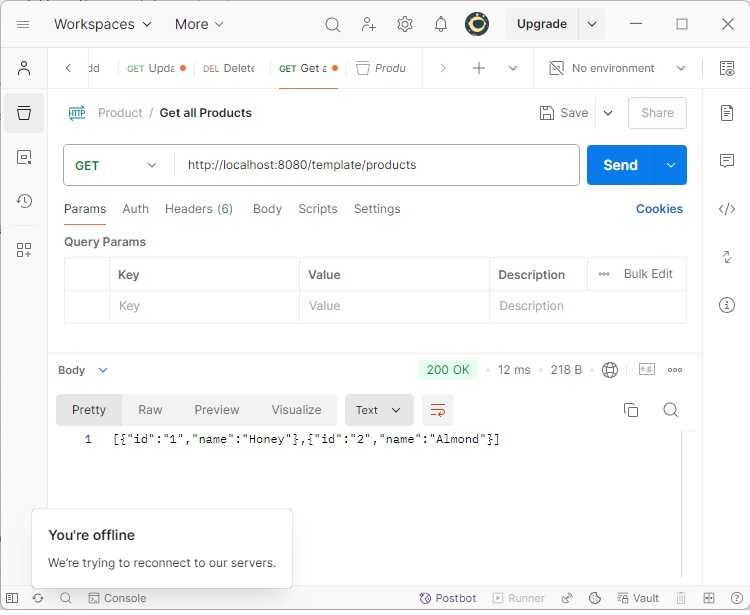
通过 Rest Template 获取 Products − http://localhost:8080/template/products
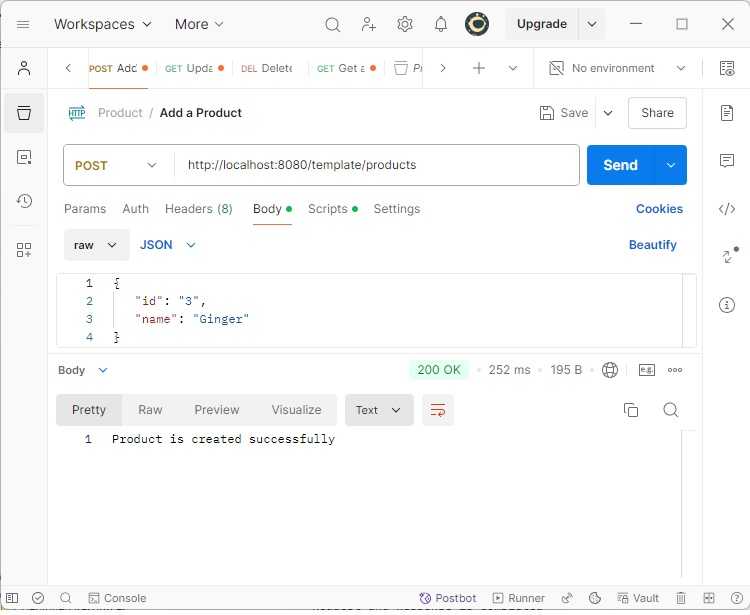
创建 Products POST − http://localhost:8080/template/products
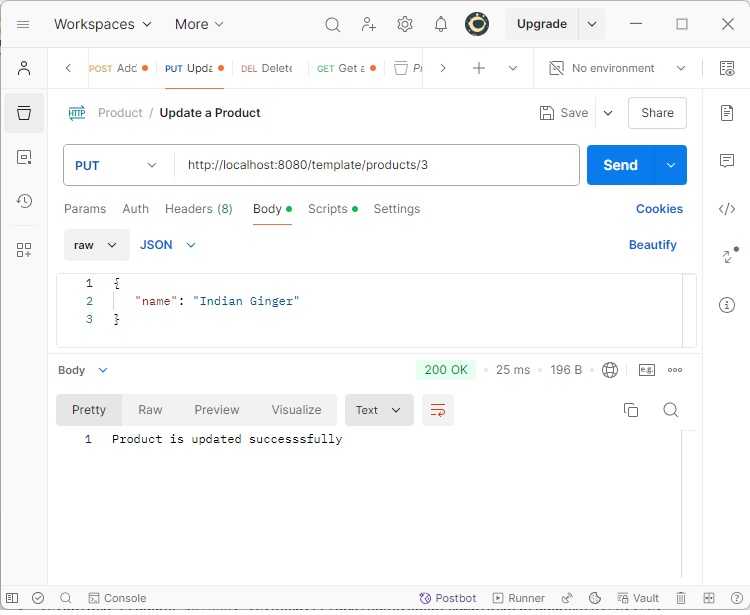
更新 Product PUT − http://localhost:8080/template/products/3
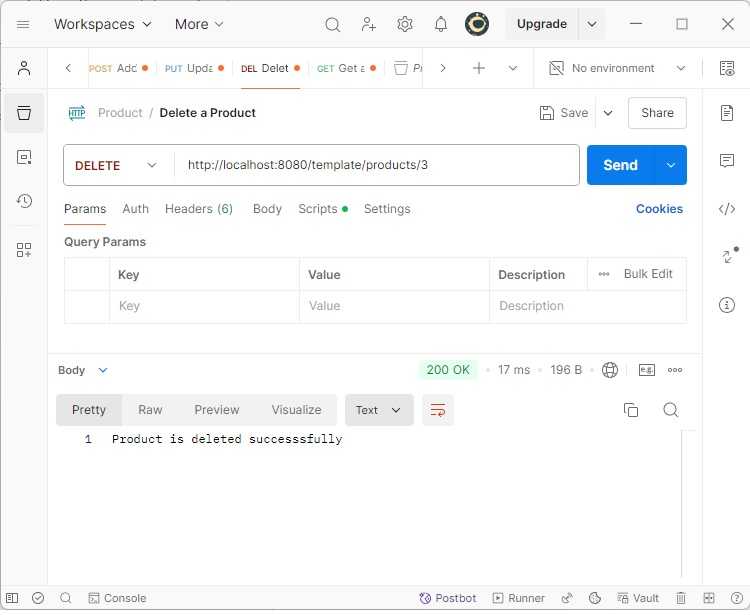
删除 Product − http://localhost:8080/template/products/3